
MSEA and the 2026 General Assembly
What We’re Fighting For

The 2026 legislative session will be pivotal for Marylanders, educators, and students. Elected officials can continue to build on the strong history of commitment to our public schools by the governor and the legislature in the final year of their terms before November’s election, when every seat in the General Assembly is on the ballot.
Legislators are also facing a number of significant budgetary obstacles and uncertainty fueled by the chaotic and harmful federal actions which have negatively affected Maryland families and have created an unexpected state budget deficit. See how Gov. Wes Moore is trying to protect public education in his proposed budget here.
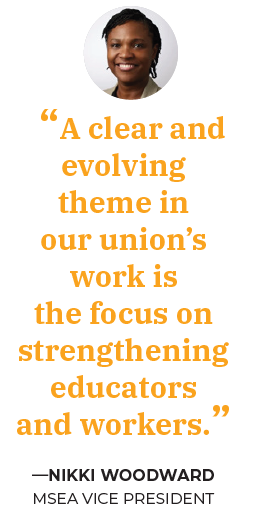
“A clear and evolving theme in our union’s work is the focus on strengthening educators and workers,” says MSEA Vice President Nikki Woodward. “This includes tackling staffing shortages and overwhelming workloads, advancing the ESP Bill of Rights, and expanding collective bargaining and strike protections.
“At its heart, this reflects a belief that student success depends on good working conditions for educators. Students perform better when educators receive fair pay, reasonable hours, and a genuine voice at work. This idea has guided MSEA’s advocacy for years and continues to grow more powerful and ambitious with each legislative cycle,” Woodward added.
Get up-to-date budget updates in Up the Street, MSEA’s weekly update on Maryland’s 2026 General Assembly here.
Keeping and Funding Our Commitment to Public Education Unfortunately, Marylanders and Maryland’s economy are seeing the consequences of short-sighted decisions from the federal government. This is leading to higher costs for the state, schools, and all Marylanders, and reducing the amount of revenue the state has to provide essential services to its residents. “We must make sure Maryland protects our kids against the damage Donald Trump is doing to the budgets and policies underpinning public education and social programs,” said MSEA President Paul Lemle.
We applaud the work the legislature did last year to raise revenue and ensure everyone is paying their fair share and encourage continued consideration of progressive revenue improvements. The state must also work with local governments to help them raise additional revenue while lessening the burden on working people. Policies to raise additional local revenue may include allowing for variability in the property tax.
Holistically Measuring School Success Maryland educators have long been involved in the conversation about the role of assessments in measuring learning—and the shortcomings and negative ripple effects of the overwhelming focus on mandated standardized testing. In recent years, we have successfully advocated for more balanced school quality indicators that consider school climate and a well-rounded curriculum in addition to standardized test scores, plus guidelines to minimize the impact of testing on learning time.

This year, MSDE convened the Accountability Advisory Committee to review Maryland’s school star rating system. The committee continued the work of the 2024 Task Force on School Assessment and Accountability, which made initial recommendations in December 2024. “Our school rating system should not stigmatize schools and perpetuate segregation, and ideally should be a descriptive system instead of the current star ratings,” said Lemle. “We will continue to advocate for holistic measures of school success that reflect students’ overall experience rather than a myopic focus on test scores that narrows curriculum, student opportunities, and the joy of learning.”
Protecting Vulnerable Marylanders Marylanders face the impacts of deepening poverty, immigration crack-downs, food insecurity, and potential federal government shutdowns. We will support policies that protect families, students, and communities.
We will support proactive measures to protect our freedoms and our students, including but not limited to: preventing destructive mass deportations and traumatizing ICE actions at our schools; ensuring access to reliable health care; protecting our democracy and elections; providing protections for LGBTQ+ students, educators, and community members; and opposing the massive funding cuts and loss of anti-discrimination protections that would result if the U.S. Department of Education was closed.

The sweeping cuts and disruption to the Department of Education make it all the more critical that we protect at-promise students in Maryland, including ensuring that students receiving special education services are getting the support and staffing they need.
Technology in Education The mental well-being of students and their readiness to learn is placed at risk when schools and classrooms are subjected to frequent interference from electronic devices and social conflict that may arise from the use of social media during the school day. MSEA will also engage in conversations about guardrails around the use of AI in our school systems.
Protecting and Expanding Union Rights From fighting for the ESP Bill of Rights, to expanding organizing protections, to ensuring educators have a meaningful voice in decisions, strengthening worker power remains central to our mission. MSEA supports ensuring that educators have a right to strike without sanctions against their licenses or their unions—as educators in many other states do and as private employees do.
Standing Firm Against Vouchers With federal proposals like the new Trump voucher plan in the One Big Beautiful Bill, the threat of diverting public dollars to private schools is real. MSEA will continue to oppose any voucher scheme or expansion that drains resources from public schools.

Continuing to Address the Educator Shortage, Retention, and Workload The pipeline of educators continues to be insufficient due to challenging working conditions and years of inadequate pay. We know the staffing shortage affects the academic achievement, emotional wellness, and safety of our students. We must protect funding for programs that are working, like Grow Your Own and teacher apprenticeships, and look for new opportunities to reduce excessive workload and sustain our education workforce.