
Session Ends with Wins for ESPs, Accountability System, Funding
And other legislative updates in this week’s Up the Street
SINE DIE EDITION
Session Ends with Wins for School Accountability, ESP Rights, Better Policy
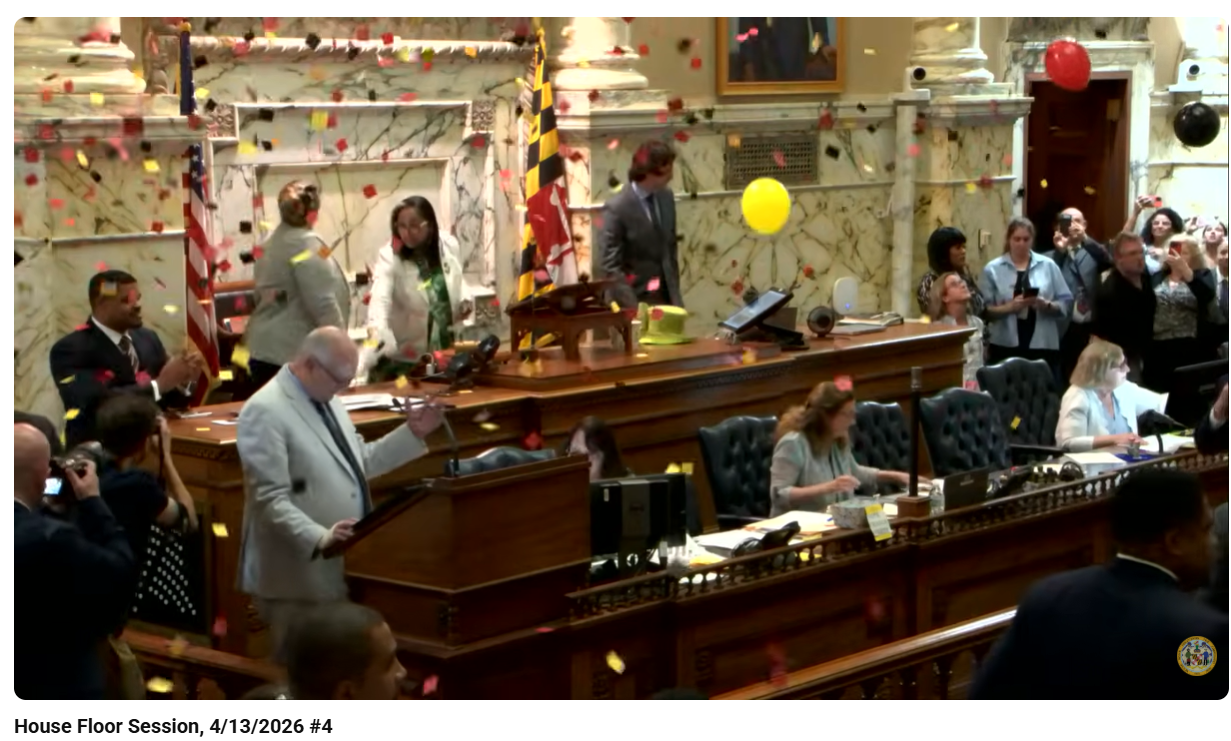
When the confetti concluded the 448th General Assembly session on Monday at midnight educators could celebrate some important new laws and historic firsts. MSEA tracked 417 bills during the session to improve educators’ profession, expand equity for students, and support worker and civil rights for Marylanders. This session featured a historic first and some new leadership as Afro-Latina Joseline Peña-Melnyk (D-Prince George’s and Anne Arundel) was voted by her peers to become Speaker of the House of Delegates. She had the support of her predecessor, Del. Adrienne Jones (D-Baltimore County), who is retiring this year and leaves a legacy of strong support for educators, students, and public school funding.
In laws passed and bills defeated under the new leadership and committee structures, MSEA counted wins in every category of its 2026 legislative priorities: protecting public education investments, developing a fairer school rating system, establishing guardrails around technology in the classroom, standing firm against vouchers, reducing the educator shortage, strengthening worker rights, and defending Maryland’s most vulnerable people.
Lawmakers agreed swiftly on a $71 billion budget that maintained strong funding for public pre-K-12 education. They resolved a $1.5 billion budget deficit with fund swaps and delays that will not be available next session, when a budget deficit is again predicted and education advocates will need to be heard loud and clear to protect critical investments started and promised in the Blueprint for Maryland’s Future.
$10.2 Billion for K-12 Education Is $373 Million Increase, Upholds Blueprint
The fiscal year 2027 budget includes $10.2 billion for public education, which continues strong state investment in Maryland’s public schools. That support is especially important as federal cuts are being made to programs that support the most vulnerable students and aspiring educators. In the budget there is:
- $572 million (16% increase) for community schools
- $19.4 million for Grow Your Own educator program continuation
- $228 million correction in lapse of compensatory education eligibility
- $480.5 million capital budget for school construction
The continued investment in our schools through the Blueprint underpins increases in student achievement, nation-leading expansion in community schools, the dramatic narrowing of the educator shortage and increases in educator salaries, exciting new career technical education programs, and rapid, substantial increases in Nationally Board Certified teachers, among many other strong signs of progress. The return on investment—and need to sustain those investments—despite federal budgetary headwinds is crystal clear.
COMPASS Act Develops Better, Fairer Star Rating System
MSEA approached the session with the conviction that test scores alone cannot define student or school success. In an amended House Bill 1582, the COMPASS Act, MSEA supported the Maryland State Department of Education’s guardrails for the new rating system that will more holistically captures academic growth, school climate, well-rounded curriculum, and the many indicators that truly reflect student opportunity. Passed by the House (98-37) and Senate (36-11), this rating framework should make it easier to understand school performance, measure meaningful school characteristics, and help better measure student growth. Based on the guardrails now in law, the State Board of Education will start its work developing the new report card.
Rights Expand for ESPs, Other Allied Workers
In support of the ESP Bill of Rights, MSEA advanced several bills that help empower education support professionals (ESPs). While not all of the bills passed, several made important strides and set up opportunities for the future. An amended House Bill 828, sponsored by Del. Eric Ebersole (D-Baltimore County), passed with unanimous votes in the House and Senate. HB828 makes it possible for an ESP to be appointed to the State Board of Education, as MSEA has advocated for several years.
A $25 per hour salary for ESPs and a living wage for all did not pass, but they came closer to success this session. Senate Bill 764, sponsored by Sen. Craig Zucker (D-Montgomery), to pay all ESPs a minimum $25 per hour, was amended to conduct a study of the financial impact of that plan. It passed the Senate and had a favorable report from the House Ways and Means Committee, but the bill did not get a final vote in either chamber. Hearings were held on the Living Wage for All bills, House Bill 1229/Senate Bill 886, sponsored respectively by Del. Vaughn Stewart (D-Montgomery) and Sen. Anthony Muse (D-Prince George’s). MSEA will continue the fight for this legislation to recognize the essential work that ESPs do.
Crossfiled bills House Bill 1254/Senate Bill 904, sponsored by Del. Jessica Feldmark (D-Howard) and Sen. Zucker, respectively, would have prohibited the outsourcing of school-based jobs to non-school based staff and would have granted time to ESPs for professional development had versions that passed in both chambers, but in different forms. Neither bill ultimately passed both chambers in the same form, which would be necessary to get it to the governor’s desk. But passing separate legislation against outsourcing and for real, job-embedded professional development will continue to be legislative priorities in the future.
House Bill 849 and House Bill 1321 will benefit ESPs in public pre-kindergarten positions with help paying for childcare. This will make changes to the Child Care Scholarship (CCS) program administered by the Maryland State Department of Education (MSDE) to include a partial scholarship for families making above a certain amount of income that will help to fund additional child care slots in the program, as well as changes to the prioritization of families seeking care.
Other pro-worker bills passed with MSEA support. A decade-long effort to extend collective bargaining rights to graduate assistants achieved success at last this year in House Bill 141 sponsored by Del. Linda Foley (D-Montgomery). Foley credited Speaker Peña-Melnyk with notable support this year. “We’ve had support from the speaker’s office in the past, but we now really have someone who is a champion for workers rights, and particularly workers rights for collective bargaining,” said Foley. This year Senate Bill 6, sponsored by Sen. Ben Kramer (D-Montgomery), gives nontenure track faculty at community colleges the right to collectively bargain. House Bill 604/Senate Bill 28, which creates a referendum on binding arbitration for state employees, will be a ballot initiative in November to amend the state Constitution. HB60/SB28 was sponsored respectively by Del. Jared Solomon (D-Montgomery) and Sen. Cory McCray (D-Baltimore City).
Progress also occurred this year toward getting educators the right to strike without sanctions against their licenses or their unions, as educators in many other states do, and as private employees do. House Bill 1492, sponsored Del. Eric Ebersole (D-Baltimore County), had a strong hearing in the Government, Labor, and Elections Committee with MSEA member testimony, and pressure will continue to obtain this bedrock labor right.
Use of Technology in Schools Gains Guardrails
On its way to the governor for signature is House Bill 525, requiring county boards of education to establish student technology (cell phone) use policies by 2027-2028 school year. One of MSEA’s top priorities, this legislation was sponsored by Del. Adrian Boafo (D-Prince George’s). It requires local school systems to have clear policies and consistent enforcement around personal technology devices in the classroom to reduce student distraction and school disruption.
The use, availability, and challenges posed by artificial intelligence (AI) in education also requires consideration, clear expectations, and guidance for students and educators. MSEA advocated for the successful Senate Bill 720 for county boards of education to establish guidelines for the use of AI in schools. Sen. Katie Fry Hester (D-Howard and Montgomery) sponsored the legislation.
MSEA also supported Senate Bill 375, to require local boards of education to train their members in AI. It had a hearing but did not get out of the Education, Energy, and the Environment Committee.
New Laws Protect Public Education Investments
MSEA advocated for House Bill 1142 to establish a task force to modernize county revenue options. On its way to the governor’s desk for signature, HB1142 was sponsored by Ways and Means Committee Chair Del. Jheanelle Wilkins (D-Montgomery). The findings of this task force could help provide options for county government to continue their investments in public education.
One set of crossfiled bills with MSEA support that did not pass, Senate Bill 170/House Bill 64, sponsored by Frederick Democrats Sen. Karen Lewis Young and Del. Kris Fair, would have established a more accurate enrollment count, particularly in districts with rapid student growth. MSEA will continue to advocate for accurate enrollment counts on which responsible education funding depends.
Bills Prevent Voucher Expansion
The threat of increased public dollars going to private schools grew exponentially with the Trump Administration’s One Big Beautiful Bill voucher plan. MSEA opposed the state’s participating in the voucher scheme as proposed in House Bill 455/Senate Bill 329. HB455/SB329 would have enabled the Trump voucher schemes to benefit private and religious schools without accountability. The legislation was sponsored by Del. April Miller (R-Frederick) and Sen. Bill Folden (R-Frederick), respectively, and the bills did not get out of their original committees. While MSEA celebrated the failure of that legislation, House Bill 930, which MSEA supported, could have prohibited Maryland from entering into the Trump voucher tax credit program, and it did not get out of the Ways and Means Committee. Del. Catherine Forbes (D-Baltimore County) sponsored the anti-voucher legislation.
Progress Continues to Reduce Educator Shortage
Several new laws help reduce the educator shortage. That includes the FY27 budget, which again includes $19.4 million for the Grow Your Own program that builds on the Blueprint’s supports for active and aspiring educators. House Bill 340/Senate Bill 238, which passed unanimously in both the House and Senate, establishes an interstate compact to ease hiring of school psychologists. Del. Bernice Mireku-North (D-Montgomery) and Sen. Malcolm Augustine (D-Prince George’s) sponsored HB340/SB238 respectively. House Bill 1192/Senate Bill 645 also passed both chambers unanimously and extends licensure timelines and updates licensure requirements for sign language interpreters. Del. Heather Bagnall (D-Anne Arundel) and Sen. Nancy King (D-Montgomery) sponsored HB1192/SB645 respectively. Del. Edith Patterson (D-Charles) and Sen. Bryan Simonaire (R-Anne Arundel) sponsored House Bill 478/Senate Bill 262, to give tax relief to prekindergarten educators who pay out of pocket for school supplies. Both bills passed unanimously in both chambers. House Bill 168, sponsored by Del. Joe Vogel (D-Montgomery), passed to give educators access to certain affordable housing programs.
MSEA will continue to fight to correct the eligibility status of some Nationally Board Certified educators who, because of a technicality in the Blueprint, have been omitted from bonuses due to longer maintenance of certification windows. This year, Senate Bill 957/House Bill 1115, sponsored respectively by Sen. Dawn Gile (D-Anne Arundel) and Del. Andrew Pruski (D-Anne Arundel), successfully passed the Senate, but did not get a final vote in the House.
Other Bills Improve Financial Conditions for Students, Educators
House Bill 575, sponsored by Ways and Means Committee Chair Del. Wilkins, excuses student absences for civic engagement opportunities, and House Bill 1530 eases the tax filing requirements for people who are covered by the DREAM Act for immigrants. Senate Bill 805, sponsored by Sen. Shelly Hettleman (D-Baltimore County), passed unanimously in the Senate, and on a vote of 128-8 in the House to give debt relief to student loan borrowers. All three of these important measures are headed to the governor’s desk for his expected signature.
Racial, Social Justice Laws Protect Maryland’s Most Vulnerable from Federal Overreach
MSEA’s legislative priorities included policies that protect families, students, and communities from traumatizing actions by the Immigration and Customs Enforcement (ICE) officers; ensure access to healthcare; preserve democracy and elections; and protect civil and human rights for the LGBTQ+ community that are at risk under the Trump Administration. MSEA supported an amended Senate Bill 1, sponsored by Sen. Malcolm Augustine (D-Prince George’s), to prohibit law enforcement from wearing face masks, and an amended Senate Bill 810, sponsored by Sen. Nancy King (D-Montgomery), expanding the definition of sensitive locations, to include bus stops, and to prohibit school security from engaging in immigration actions. Sponsored by Del. Nicole Williams (D-Prince George’s) and Sen. Will Smith (D-Montgomery), House Bill 444/Senate Bill 245, emergency legislation that passed early in the session, prohibits local law enforcement from entering into immigration enforcement agreements with ICE, and the Community Trust Act, Senate Bill 791 sponsored by Sen. Clarence Lam (D-Anne Arundel and Howard), passed yesterday, to include correction officers in the prohibition. The Voting Rights Act of 2026, Senate Bill 255, sponsored by Sen. Charles Sydnor (D-Baltimore County), passed to protect full access to voting for all eligible voters, critically important at a time when the U.S. Supreme Court is sending signals that they will strike down the federal Voting Rights Act. The No Kings Act, Senate Bill 346, sponsored by Sen. Jeff Waldstreicher (D-Montgomery), was passed with MSEA support to establish civil liability for depriving someone of constitutional rights. Additional new laws protect data privacy and prohibit the approval of private ICE facilities.
Bad Bills Mostly Failed; Efforts Remain to Focus Limited Resources on Blueprint Goals
In support of the objectives of the Blueprint for Maryland’s Future, MSEA opposed House Bill 803, which failed. It would have cut educators’ planning and collaborative time that is supposed to increase to 40% of their day. Sponsored by April Miller (R-Frederick), HB803 would have cut collaborative time to 20%.
Republican bills to discriminate against transgender students failed. Senate Bill 50, sponsored by Sen. Mary Beth Carozza (R-Somerset, Worcester, and Wicomico) would have denied transgender athletes access to school sport teams, and House Bill 63, sponsored by Del. Kathy Szeliga (R-Baltimore County) would have restricted transgender athletes access to locker rooms based on sex at birth.
Regrettably, House Bill 1430 passed to create a dedicated funding stream for charter school facilities that does not exist for traditional schools. While charter facilities deserve attention, it should be part of a more complete school construction and school maintenance program that does not advantage charters over traditional schools. The unmet needs are enormous, but under this legislation, charter needs are met first.
What Comes Next Will Depend on Educator Engagement
To build on this year’s progress, educators and allies will have to fight next year to maintain strong, adequate, and equitable pre-K-12 public education that is essential to provide resources for populations where equity has historically fallen short. Unpredictable, chaotic, and destructive actions from the federal government are undercutting Maryland’s economy and budget and stressing the state budget. Educators, parents, and students know that a strong economy runs through strong schools and that the progress we’ve made in our public schools thanks to strong investments should not be retreated from. The interim period between this session and next will be about electing champions for our schools, understanding from the Blueprint’s interim report where improvements and changes can be made that will benefit students in the long-term, and strong advocacy for the resources and support that every student in every neighborhood deserves.
In dozens of bill hearings this session, legislators learned what matters to students and schools through testimony from active educators, MSEA governance, and staff. MSEA will continue the fight for strong funding for our schools; reducing the educator shortage; improved rights for workers; expanding racial, social, and economic justice; and better working conditions in schools. Delivering a world-class education that provides all students, no matter who they are or where they live, the opportunity to pursue their dreams depends on educator voices being loud and being heard.