
MSEA Pushes for Better Report Card School Accountability System, Worker Rights
And other legislative updates in this week’s Up the Street
THIS WEEK IN ANNAPOLIS
MSEA Advocates for Better Report Card School Accountability System
This week featured the introduction of House Bill 1582, legislation that would alter the star rating school accountability system that produces the Maryland’s annual school report cards. The legislation was introduced by the Maryland State Department of Education (MSDE), in consultation with MSEA. As introduced, House Bill 1582—the Comprehensive Outcomes and Measures of Progress for Supporting Schools, or COMPASS Act, is consistent with important guardrails around accountability measures that were established by the Protect Our Schools Act (POSA) that MSEA fought to pass in 2017.
POSA put reasonable guardrails on the amount of standardized testing that could factor into the school rating system. According to POSA, no more than 65% of a school’s star rating could be based on standardized test scores. The remainder of the score is based on School Quality and Student Success (SQSS) indicators—holistic, non-academic measures of school environment and opportunity. POSA responded to overwhelming feedback from educators, parents, and students that far too much time and focus was being spent on standardized testing completion and preparation, narrowing the curriculum and crowding out time for more dynamic and engaging teaching and learning.
The COMPASS Act would be the first update to POSA since its passage. HB1582 retains many of POSA’s important principles and also promotes academic growth and would add the option to measure staffing indicators as part of the SQSS component. MSEA advocates for the report card to utilize a descriptive model that prioritizes transparency, context, equity, and continuous improvement over labeling and scores that overly reduce and simplify the strengths and areas of improvement for individual schools.
The bill is scheduled for its first hearing on March 12 in the House Ways and Means Committee.
Legislation Would Give Educators Right to Strike
Another priority bill that was introduced this week would give educators the right to strike. The right to strike without penalty is a bedrock principle in organized labor that Maryland’s educators are denied—and one that is legal for educators in many other states, as well as for private sector employees. Sponsored by Eric Ebersole (D-Baltimore County), House Bill 1492 would apply to educators and librarians. The bill will be heard in the Government, Labor, and Elections Committee.
MSEA Members Strengthen Advocacy to Support Profession, Worker Rights
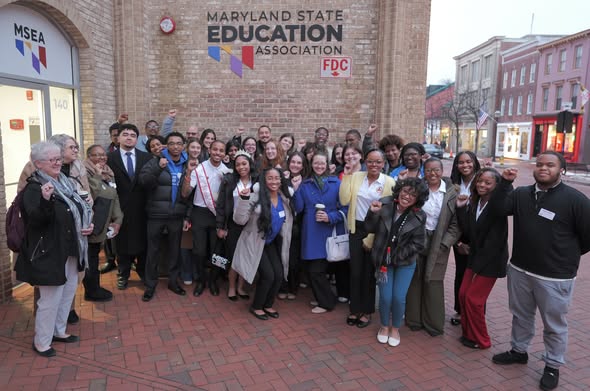
On Monday, aspiring educator members of MSEA fanned out to General Assembly members’ offices to advocate for measures to improve the educator pipeline and worker rights, among other issues. In recent weeks, scores of MSEA members have lobbied their legislators and helped them understand issues important to educators.
House Bill 473, addresses a longstanding priority for MSEA to make class size a legal subject of bargaining. Maryland is one of only nine states where educators are barred from even talking about the maximum number of students in a class while bargaining. On a panel with representatives from the Baltimore Teachers Union, MSEA President Paul Lemle informed the Government, Labor, and Elections Committee that allowing class size to be a subject of negotiation would empower educators to create better working conditions, which in turn would contribute to improved educator hiring and retention and improved classroom conditions for students. Committee members asked clarifying questions that revealed the need to remove class size negotiations from the list of illegal topics in the collective bargaining process. HB473 is sponsored by Del. Jessica Feldmark (D-Howard).
This week MSEA also provided testimony in two dozen hearings on bills to expand worker rights, reduce the educator shortage, increase educator representation in their profession, strengthen voting rights, improve health, and expand fair housing, among other issues.
Worker Rights
MSEA testified Wednesday and Thursday on Senate Bill 417, sponsored by Sen. Clarence Lam (Anne Arundel and Howard), to protect rights of workers when employers host religious meetings in the Senate Finance Committee. The crossfile is House Bill 45, sponsored by Del. Joe Vogel (D-Montgomery), in the House Government, Labor, and Elections Committee.
Cell Phones in School
MSEA advocated for county boards of education to establish student technology (cell phone) use policies, on Wednesday in the House Ways and Means Committee during the hearing on House Bill 525, sponsored by Adrian Boafo (D-Prince George’s). The crossfile is Senate Bill 928, sponsored by Sen. Kevin Harris (D-Prince George’s, Charles and Calvert), to be heard in the Senate Education, Energy, and the Environment on March 4.
Educator Shortage
On Wednesday in the Senate Education, Energy, and the Environment Committee, MSEA supported Senate Bill 238, sponsored by Sen. Malcolm Augustine (D-Prince George’s), to establish the School Psychologist Interstate Licensure Compact to help qualified psychologists from other states work in Maryland. The crossfile is House Bill 340, sponsored by Del. Bernice Mireku-North (D-Montgomery).
Voting Rights
To protect democracy and voting rights, MSEA supported House Bill 332, the No Kings Act, in the House Judiciary Committee on Wednesday, sponsored by Del. Lorig Charkoudian (D-Montgomery). It would establish civil liability for someone under color of law to deprive anyone of their constitutional rights. The crossfile is Senate Bill 346, sponsored by Sen. Jeff Waldstreicher (D-Montgomery).
Governor Signs Law to Curtail Local Involvement in Federal Immigration Enforcement
Last week the General Assembly responded to the terror generated by overly aggressive enforcement of immigration law around the country by passing Senate Bill 245/House Bill 444, and on Tuesday, Gov. Moore signed the legislation—effective immediately—to prohibit U.S. Immigration and Customs Enforcement (ICE) from deputizing local officers for federal civil immigration enforcement activity.
“This bill draws a clear line: We will continue to work with federal partners to hold violent offenders accountable, but we refuse to blur the lines between state and federal authority in ways that undermine the trust between law enforcement and the communities they serve,” Moore announced. “In Maryland, we defend constitutional rights and constitutional policing—and we will not allow untrained, unqualified, and unaccountable ICE agents to deputize our law enforcement officers.”
Nine Maryland counties have cooperative agreements with ICE that would have to cease under the new law: Allegany, Carroll, Cecil, Frederick, Garrett, Harford, St. Mary’s, Washington, and Wicomico.
SB245 was introduced by Sen. Will Smith (D-Montgomery) and crossfiled with HB444, sponsored by Del. Nicole Williams (D-Prince George’s).
Though school raids have not occurred in Maryland, educators around the country are reporting the negative consequences for students experiencing the Trump Administration’s aggressive immigration enforcement, and immigrant student absences are on the rise due to increased ICE activities around schools. Maryland schools are empowered to protect students under a state law passed last year that requires them to deny ICE agents access to areas that aren’t publicly accessible unless it is an emergency or they have a judicial warrant signed by a federal judge or magistrate.
NEWS AND NOTES
Muslim Caucus Established; Space Given to Observe Ramadan
This week saw the start of Ramadan and the founding of the Muslim Caucus in the Maryland General Assembly. Monday was Muslim Lobby Day, and House Speaker Joseline Peña-Melnyk (D-Prince George’s and Anne Arundel) made it possible for Dels. Sean Stinnett (D-Baltimore City), Caylin Young (D-Baltimore City), and Sarah Wolek (D-Montgomery) to establish the caucus and arranged for a room to be available for Muslims during Ramadan.