
MSEA and Education Advocates Urge Governor to Not Opt in to Federal Private School Voucher Program
And other legislative updates in this month’s Up the Street
THIS MONTH IN ANNAPOLIS
MSEA and Education Advocates Urge Governor to Not Opt in to Federal Private School Voucher Program
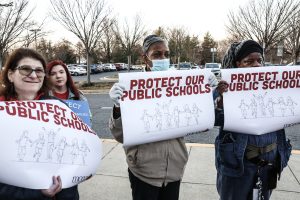
Gov. Moore—along with governors across the country—need to decide whether to take part in President Trump’s national voucher program, whether to reject this idea aimed at undercutting public school funding, or whether to punt on a decision for a future date to see how initial implementation goes.
The Baltimore Banner recently outlined the great degree of uncertainty surrounding the voucher program, which lacks many operational details from the Treasury Department. The “fundamental framework of the program is designed to funnel funds to private school tuition,” MSEA Executive Director Sean Johnson noted in the article. The program could result in the loss of upwards of $50 billion in federal funds, which will make cuts to federal Title I and IDEA funding for special education services all the more likely.
At the end of the day, this voucher program will take funds that support students in public schools and give them to private schools. While some point to the ways that a limited number of public schools may benefit from the program, the Trump Administration’s record and intentions on public education is clear: undercutting, undermining, and underfunding it every step of the way. No one should be fooled by the true goals of this Trojan Horse private school voucher program. Gov. Moore should continue his record of standing strong against voucher programs and not opt Maryland in to this program.
Education Bills Become Law at Session’s Final Bill Signing
May 26 marked the final bill signing of legislation passed during this year’s General Assembly session, with a number of education-related bills on the docket. Among the bills signed were Senate Bill 928/House Bill 525, sponsored by Sen. Kevin Harris (D-Prince George’s, Charles, and Calvert) and Del. Adrian Boafo (D-Prince George’s), which requires boards of education to establish cell phone use policies for the 2027-2028 school year. The bill was supported by MSEA as a reasonable step to limit the distractions to learning that rampant personal device use during the school day can condone. “We would like there to be cohesion around the school about how it’s enforced,” MSEA President Paul Lemle told WBOC the day after the bill was signed into law. “We want consistent, fair policies and then intelligent flexibility when that emergency comes.”
Also signed into law was the COMPASS Act (House Bill 1582), which reforms the star rating accountability system that produces the school report card that too often has been confusing and misleading. The State Board of Education will now start developing the new report card. MSEA is advocating to make the MSDE dashboard a more descriptive model. This revised rating framework should make it easier to understand school performance, measure meaningful school characteristics, and better measure student growth. Legislation to enter an interstate compact to ease the hiring of school psychologists, to require professional development and guidelines in schools concerning AI, and to end the prohibition against having an active ESP sit on the State Board were among other bills signed into law.
NEWS AND NOTES
NEA Advocates for Support of All Students, Fighting Discrimination
NEA’s Office of General Counsel is tracking Trump Administration attacks on so-called “illegal DEI” that threaten K-12 schools’ and higher education institutions’ efforts to support and serve students and educators of all backgrounds, and that also may stifle academic freedom. The administration has demanded institutions abandon “discriminatory” or “illegal” DEI activities, vaguely defined, in order to receive federal funds (which NEA already has opposed) and also to obtain federal contracts. OGC encourages members who are experiencing or concerned about impacts from these actions to share their experiences here.
SCOTUS Considers Discrimination Against LGBTQ+ Students, Athletes
The U.S. Supreme Court is considering whether a publicly funded religious school is required to admit the children of gay parents. In Colorado, one of the plaintiffs, Wellspring Catholic Academy, refused to admit an elementary school student who has same-sex parents, according to court documents from the 10th U.S. Circuit Court of Appeals. The 10th Circuit in September ruled against the plaintiffs. In other cases, the Supreme Court is to rule on the right of transgender girls to play on girls’ sports teams, and whether Title IX statute protects LGBTQ+ students. Advocates like MSEA will continue to fight for the rights of all students to have the same access to publicly funded pre-K-12 education.
CAMPAIGN 2026
Maryland’s primary is June 23, and the general election will be on Nov. 3. If a voter would like to request a mail-in ballot to be mailed or faxed to them, the deadline for that request is June 16. If a voter would like a mail-in ballot emailed to them (to then be printed), the deadline for that request is June 19. Find all of MSEA’s recommended candidates at MDAppleBallot.com.
Voter Rights at Stake as Trump, Republicans Seek Constraints on Mail-in Ballots
President Trump issued an executive order and the Supreme Court is hearing a case that could limit mail-in voting in federal elections. Maryland State Elections Administrator Jared DeMarinis said 800,000 to 1 million voters typically vote by mail in Maryland.
In the presidential order that several states call unconstitutional, Trump ordered the Department of Homeland Security to work with the Social Security Administration to make a list of eligible voters in each state and deny mail-in ballots to anyone not on each state’s approved list.
The Supreme Court case, brought by the Republican National Committee (RNC), seeks to eliminate Mississippi’s five-day grace period for mailed ballots to arrive if they are postmarked by Election Day. Maryland has a 10-day grace period, and the District of Columbia and 13 other states have varying grace periods. The federal law at issue pertains to November general elections, not primary elections.
The RNC argues that Election Day is a federally designated date after which ballots are not allowed. The 5th U.S. Circuit Court of Appeals ruled in October 2024 that federal law requires ballots to be received by Election Day.
Depending on the validity of Trump’s order and the Supreme Court’s decision, Maryland election officials and parties will have to conduct major education campaigns to inform the public of restrictions on their voting. “It could have a significant impact on mail-in voting in Maryland,” DeMarinis said. The state board is “ready to engage in voter outreach and education for mail-in voters to make sure they are not disenfranchised due to lateness or technical deficiencies.” Currently, for the general election, mail-in ballot requests should be sent in by Oct. 27 for mail or fax delivery and Oct. 30 for email delivery.