Local Union Updates
ESP Bargaining Guide, Harford’s Financial Reports, Charles’s Funding Push, and RSEJ Work in Locals

ESP’s: Focus on Bargaining As MSEA’s ESP Organizing Committee gets ready to launch the 2026 Bargaining Guide, members are focused on an aggressive push for a $25 minimum starting wage. The new guide, developed by the MSEA ESP Organizing Committee and aligned with the ESP Bill of Rights, will include a uniform member survey that connects success directly to member education on the issues and their participation in the local’s bargaining campaign.
“We know management is coordinating tactics across the state to negotiate against us,” said Stacey Albrecht, co-chair of the ESP organizing committee. “Our guide is the ultimate tool for any local ESP union to strengthen their collective bargaining campaigns.”
The guide aligns with coordinated statewide priorities and strategies and provides clear proposals, sample language, and tested talking points that help teams negotiate more effectively and confidently at the table.

Why a uniform member bargaining survey? “Our bargaining guide and the uniform member bargaining survey helps ensure we are just as coordinated, united, and strategic in our advocacy as management,” said Rachel Swartz, co-chair of the ESP Organizing Committee. “It means every local union isn’t starting from scratch but building on research and information collected from across the state to inform our campaigns to raise wages, improve working conditions, and expand our rights.”
When ESP locals use the Bargaining Guide and a common survey (edited to reflect local needs), ESP locals can increase their leverage, stay connected with broader campaigns, and win stronger contracts for their members, including a $25 minimum starting wage.

Charles County Takes Action on Funding The Education Association of Charles County (EACC) members are organizing countywide for full funding for public schools. The Board of County Commissioners (BOCC) has underfunded schools consistently since 2020 claiming the district is too poor or financially unstable to fully fund public education, but the numbers tell a different story.
Charles County is fourth in property wealth and second in income wealth in the state. As in many counties, county commissioners have decreased school funding while inflation and needs have increased. Class size is the highest in the state at 27.5 students.
To disguise its consistent agenda of under-resourcing public schools, the BOCC combines the funding for public libraries, the College of Southern Maryland, and Charles County Public Schools together under “public education.”
This gives a false and inflated impression of the actual percentage of the county’s revenue that public schools receive. Naturally educator salaries have suffered. “Staff salaries cannot continue to be the default first cut for the school budget,” said EACC President Sean Heyl. Citing the frequent bargaining schedules for EACC, Heyl added, “If you need to renegotiate a two-year contract twice, it was never a true agreement.”
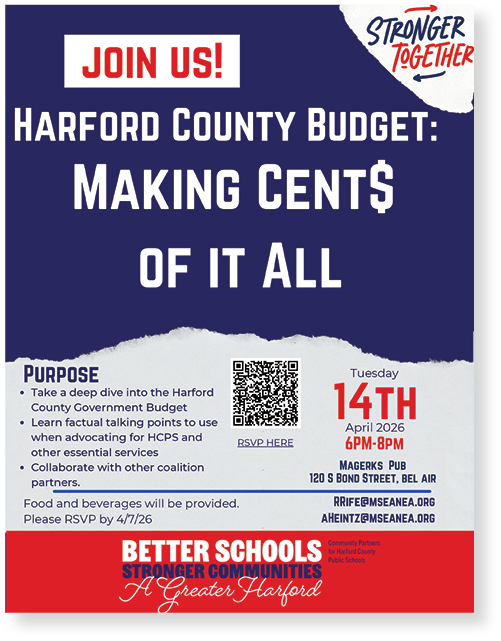
Harford County: Making Cent$ of It All Nearly 80 members of the public and the Harford County Education Association (HCEA) came out for a presentation to help community members understand the oddities of the county’s budget. For example, the county’s annual budgets categorize finances differently than its audited financial statements, making it challenging to compare actual to budgeted figures. It’s a complicated story, but one the public needs to know to make informed decisions.
The Making Cent$ of It All presentation, sponsored by HCEA’s coalition partner Better Schools Stronger Communities, A Greater Harford brought some clarity to the county’s financial woes, but questions remain regarding the county’s huge debt service payments, annually underestimated income tax revenues ($40 million alone in 2025), and revenues that exceed budget estimates all while shorting public schools and students and threatening the county’s future and workforce.
A better understanding of the county’s bookkeeping means citizens can support more school funding, knowing it can be achieved without increasing taxes.
Racial, Social, and Economic Justice Work Taking Off in Anne Arundel, Baltimore, and Dorchester Counties For any organization engaging in racial, social, and economic justice (RSEJ) efforts, the reasons are many. For some, they want to increase community engagement. Others might hope to build relationships with new groups. Still others desire to more successfully connect with existing members, friends, and the public. But getting there requires guidance and work. We’ve learned that there’s a gap in connecting on issues that have often not been addressed because there was no leadership, the issues weren’t named, there was no common or perceived need nor a common forum to come together, or there was simply no willingness. Facing the gap and wanting to do something about it requires courage, introspection, humanity, humility, and judgment-free support.
While the reasons may vary for MSEA’s individual local unions, the leaders and members of the Teachers Association of Anne Arundel County (TAAAC), the Education Support Professionals of Baltimore County (ESPBC), Dorchester Educators (DE, a merged local of licensed and support staff), Harford County Education Association (also a merged local), and the Cecil County Classroom Teachers Association are in stages of developing and implementing local plans through MSEA’s RSEJ Local Targeted Organizing Program.
The locals received $10,000 plus resources and support to help them reach the goals of the program, which include:
- Advancing racial and social justice
- Building and using power to increase support for public education
- Empowering and elevating educator voice
- Enhancing organizational capacity
- Recruiting, engaging, and organizing a diverse membership
- Building community partnerships, and individual and collective action and movement building
- Supporting professional excellence
Of those five, ESPBC, DE, and TAAAC attended NEA’s Advancing Racial Justice Conference this winter in Annapolis. For those members, trainers from the NEA Center for Organizing and the NEA Center for Social Justice set goals to build participants’ skills through awareness of white supremacy culture, interpersonal racism, and systemic racism.