
Governor’s Budget Sees Public Schools As Foundation of Everything
And other legislative updates in this week’s Up the Street
THIS WEEK IN ANNAPOLIS
Budget Keeps Commitment to Education as State’s Foundation
The governor presented a $71 billion state budget for fiscal year 2027 built on three foundational pillars: protect Marylanders, increase affordability, and increase Maryland’s economic competitiveness. The governor emphasized that those three pillars depend on K-12 public education. “Our schools are the foundation on which we build everything else,” he said. Protecting Marylanders includes preserving and enhancing support for health care, food assistance and community-driven efforts to tackle child poverty.
With Moore’s support, mid-way in the Blueprint for Maryland’s Future’s implementation, progress is evident in better supported schools and higher achievement; almost 45% of Maryland’s 1,400 schools are community schools, compared to 18% in 2021. Community schools are able to provide wraparound services, such as extended learning time and enrichment experiences, nutritious food, behavioral health services, family supports, transportation, and other opportunities. The Blueprint’s holistic programs and emphasis on community schools dovetail with the budget’s overall ambitions. Additionally, the educator shortage is down by almost 50% of what it was two years ago. The governor’s FY27 budget includes additional funding to further reduce the educator shortage, as well as to upgrade aging schools and provide critical funding for the most vulnerable, at-promise, students.
Targeting educator shortages is a critical goal of the governor’s $19 million investment in Grow Your Own (GYO) programs to assist non-certificated school staff who choose to become teachers. MSEA President Paul Lemle said, “It’s critically important that we expand high-quality pathways to becoming an educator. The governor’s budget, and its strong funding for Grow Your Own programs recognizes that teaching is a profession that requires investment, training, and support. These programs meet the needs of our students, and our future, by providing great teachers to schools across the state. They also open a door into teaching for students and workers who are currently in other roles, but whose career goals include making a difference in our classrooms.”
In balancing the budget, the governor started with a $1.4 billion deficit, largely a consequence of the Trump Administration’s cuts to federal social safety nets, disaster funds, and employment in 2025. Moore’s budget proposes to go beyond just recovering from the federally created chaos, and to continue to make progress in education expansion, economic growth, and poverty reduction.
The governor’s proposed budget includes:
- $572 million (16% increase) for community schools
- $19.4 million for GYO educator program continuation
- $442 for compensatory education (including $228 million correction in lapse of compensatory education eligibility)
- $480.5 million Capital Budget for school construction
- $353 million in expanded housing supply and community revitalization
- $414 million to support the Child Care Scholarship
- $16.7 million for food banks and nutrition services, including the Maryland Food Bank and the Capital Area Food Bank
To balance the budget the governor made one-time transfers, maintained the Rainy Day reserve fund at the recommended 8%, included a $100 million balance, and did not raise fees or taxes. The transfers came from several sources:
- $322 million from the capital budget
- $292 million from the Strategic Energy Investment Fund
- $187 million from the fiscal responsibility fund
- $150 million from the local income tax reserve
- $145 million from the Rainy Day Fund
The proposed budget also shifts, similar to last year’s budget, some additional pension costs for educators, librarians, and community college workers to the counties, and it reduces the state share of non-public placements for students needing special services by 10%. The massive federal shifting of costs to states—along with deep federal cuts to Maryland’s economy—create huge obligations and pressure on the state to backfill those shifts. The governor’s budget addresses some of those costs with these further shifts to counties, which will likely create challenges for local budgets in some jurisdictions. Some details about the governor’s FY27 spending proposal are not clear yet, but will be as further analysis from the Department of Legislative Services is shared out. MSEA will follow closely and prepare to advocate accordingly.
Annapolis Hears Demands for Living Wage for All
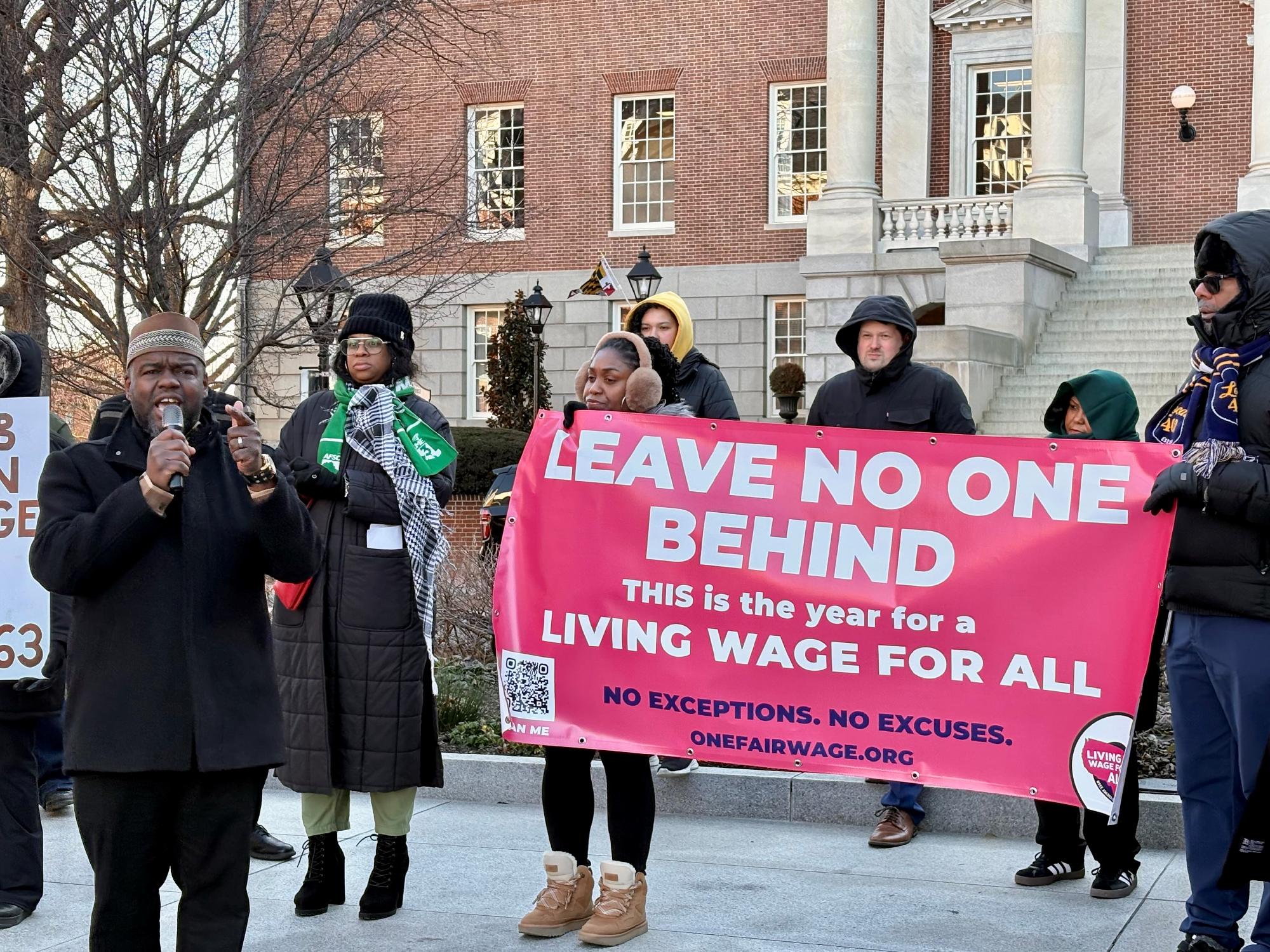
MSEA will support legislation for a living wage as one of this year’s legislative priorities. Supporters rallied in Annapolis on Tuesday for a $25 per hour minimum wage. Cortly Witherspoon, a member of Education Support Professionals of Baltimore County (ESPBC), and MSEA Vice President Nikki Woodward addressed the Living Wage for All rally alongside representatives from One Fair Wage, Service Employees International Union (SEIU) 1199, CASA, American Federation of State, County and Municipal Employees (AFSCME) Council 3, SEIU Local 500, the Maryland Center on Economic Policy, Progressive Maryland, and others. A living wage is a key pillar of MSEA’s Education Support Professionals Bill of Rights.
Woodward said, “Systems only succeed when the people who hold them up are supported. That truth certainly applies to our schools and educators. And it applies to every worker, from healthcare and childcare, to food service, retail, public service, and construction.”
Howard, Montgomery, and Prince George’s counties already have adopted their own minimum wages higher than the state mandated $15 per hour. According to a recent Gonzales Poll, 65% of Maryland voters support raising the minimum wage to $25 per hour over several years and ending subminimum wages for tipped workers.
Legislation Would Rein in ICE Activity
Nearly 50 Democrats in opposition to the fear-mongering tactics of federal Immigration and Customs Enforcement (ICE) officers are sponsoring legislation to diminish ICE’s impact on Marylanders. MSEA this week supported Senate Bills 1/House Bill 155 and Senate Bill 245/ House Bill 444 with written testimony. Both Senate bills are in the Judicial Proceedings Committee, where they were heard Thursday. SB1, sponsored by Senator Malcolm Augustine (D-Prince George’s), targets the practice of law enforcement officers wearing face coverings. Testimony involving the abduction of a woman by a masked ICE agent described a scene of terror. SB245, sponsored by Judicial Proceedings Committee Chair Senator Will Smith (D-Montgomery), would ban local governments from entering into enforcement agreements with ICE. “We should no longer divert our precious and critical law enforcement resources to federal immigration enforcement. Instead, law enforcement should be focused on public safety,” Smith said. The house bills are both sponsored by Delegate Nicole Williams (D-Prince George’s), and are pending hearings in the Judiciary Committee.
Task Force Sought to Get Accurate Enrollment, Funding for Schools
Given the important linkage between school funding and fluctuating enrollment, MSEA supports legislation to establish a task force that would analyze the challenges in getting timely and accurate information. Senate Bill 170, sponsored by Senator Karen Lewis Young (D-Frederick) is in the Budget and Taxation Committee, where it was heard on Wednesday. The bill requires the task force to report its findings in December. The crossfile, House Bill 64, sponsored by Delegate Kris Fair (D-Frederick), is in the Appropriations Committee.
MSEA Supports Revenue Options for Local Government
Local governments have long had fewer tools at their disposal than state and federal governments in generating revenue in progressive ways. Therefore, MSEA supports legislation to allow counties to establish a subclass and set a special rate for commercial and industrial property. This week MSEA supported Senate Bill 224, sponsored by Senator Karen Lewis Young (D-Frederick) in the Budget and Taxation Committee. The crossfile is House Bill 90, sponsored by Delegate Kris Fair (D-Frederick), will have a hearing on January 27 in the Ways and Means Committee.
NEWS AND NOTES
Congress Spares U.S. Education Department in Latest Budget
Both chambers of Congress on Monday proposed a U.S. Department of Education budget for the current fiscal year that would undo the 15% cuts President Trump proposed. The agreement they came to for fiscal year 2026 would give the department $217 million more than FY2025. The new budget proposal also would prohibit the Education Department from transferring statutorily required program responsibilities to other federal agencies. A continuing resolution that is funding the federal government is set to expire at the end of the month, and a vote on the budget is expected by January 30.
Black Caucus Elects Delegate N. Scott Phillips, Senator Shaneka Henson
This week the Legislative Black Caucus voted in a new chair, Delegate N. Scott Phillips (D-Baltimore County), and vice chair, Senator Shaneka Henson (D-Anne Arundel). The vacancies were created by the elevation of former Caucus Chair Jheanelle Wilkins (D-Montgomery) to chair of the Ways and Means Committee, and former Caucus Vice Chair Delegate Melissa Wells (D-Baltimore City) to chair of the new Government, Labor, and Elections Committee.