
$19 Million Grant Will Help Close Educator Shortage Gap
And other legislative updates in this month’s Up the Street
THIS MONTH IN ANNAPOLIS
Grow Your Own Grant, Recruiting Plan Tackle Educator Shortage
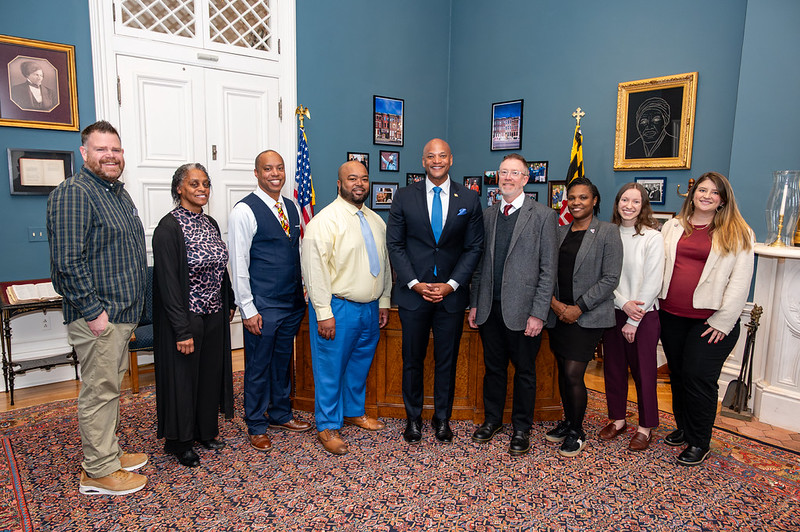
Gov. Moore announced the first round of a $19 million Grow Your Own grant program to support education support professionals (ESPs) and non-licensed school staff looking to teach, with a particular encouragement for men to join the profession. This continues the progress begun by his 2024 Educator Shortage Reduction Act and this year’s Excellence in Maryland Public Schools Act, and seeks to further reduce teacher vacancies statewide, which have dropped by nearly 50% from the 2024-25 school year to the 2025-26 school year.
Grow Your Own programs are proven to help ESPs who want to become licensed teachers. One such former ESP, Frederick County teacher and member of the MSEA Board of Directors Ronnie Beard, spoke at Tuesday’s event announcing the grants. “Grow Your Own programs changed my life, and I know it can make a big difference in the lives of so many other educators and students,” said Beard. “Grow Your Own programs will not just help recruit more teachers, they will recruit more teachers who know the students, know the school, and know the community.”
In other recruitment news from last month, the Board of Public Works, whose members are Moore, Comptroller Brooke Lierman, and Treasurer Dereck Davis, approved a four-year, $2.8 million contract with TEACH.org to recruit educators for the state. This campaign is part of the 2025 Excellence in Maryland Public Schools Act.
Federal Chaos Leads to Estimated $1.4 Billion Budget Gap in FY27, Wider Gap Beyond
The latest Spending Affordability Briefing reported that since the spring, a forecasted budget shortfall for next fiscal year has grown from a manageable few hundred million dollars to an estimated $1.4 billion, and the gap will widen in the out years, unless lawmakers take action. Federal job cuts, federal program cuts, and an increased share of costs for Medicaid, child care programs, and other services contribute to the financial outlook.
The majority of the shortage results from President Trump’s fiscal year 2026 budget bill, One Big Beautiful Bill. It will cost Maryland $371 million in reduced taxes on corporations, loss of income taxes, and other changes. Additionally, Trump’s federal layoffs has already cost Maryland 15,000 jobs since January, the most of any state. Maryland’s decision makers will need to grapple with how continued economic shocks from Washington, D.C. will be responsibly contended with in Annapolis while protecting priorities like investing in our schools and protecting Maryland’s most vulnerable residents.
Education Champion, Glass Ceiling Breaker Adrienne Jones Steps Down as House Speaker
Speaker Adrienne Jones (D-Baltimore County) is stepping down from her leadership position after leading the House of Delegates for six years. In 2019, after the death of House Speaker Mike Busch (D-Anne Arundel), Jones became the first woman and first person of color to the lead the House. She has been a member of the House since 1997.
Jones has been a fierce champion for public school students, educators, and schools across Maryland. She played an integral role in shaping and passing legislation that will have a long-lasting impact on Maryland schools and communities: from the Blueprint for Maryland’s Future and its focus on equitable investment in all students to the Built to Learn Act and its emphasis on safe, modern schools across the state, to ensuring that HBCUs receive the funding they deserve, generations of students will benefit from her leadership, advocacy, and example.
“Educators appreciate her decades of dedicated service, partnership, and leadership, and know she will continue that work as a delegate,” said MSEA President Paul Lemle. “Educators look forward to working with the next Speaker of the House to build on Speaker Jones’ legacy.”
MSEA-Endorsed Candidate Murray-Lewis Resoundingly Wins Election to State Board of Education
With 40% of the vote in a 20-candidate field, MSEA-endorsed candidate Nicole Murray-Lewis was elected by educators statewide to represent them on the Maryland State Board of Education (SBOE). Her term in office will begin no later than July 1, 2026. Her victory, following an overwhelming endorsement by the delegates at the fall MSEA Representative Assembly (RA), marks the second teacher and MSEA member to fill the position. The seat, which MSEA fought for and won in 2019, ensures that the voice of an active teacher would be heard on the State Board. “Educators, we are the only…industry where we don’t have educators regulating our industry,” Murray-Lewis said. “I feel like there are things that we need to do better. Our teachers need to be listened to.” Murray-Lewis is a Nationally Board Certified history teacher at Blake High School in Montgomery County in her 28th year of teaching.
The seat she will fill has been held since its creation by Carroll County music teacher Rachel McCusker, who is term limited. Murray-Lewis described her intention to the RA delegates to continue the progress McCusker began. “Policy must reflect the reality of our classrooms and the voices of all educators,” said Murray-Lewis. “I will work to bridge divides, lift up voices too often ignored, and advance policies that prepare every child for success in the 21st century—no matter their background or zip code.”
Blueprint Board Seeks Law Changes to Gain Educators, Serve Most Vulnerable Students
The Blueprint for Maryland’s Future’s Accountability and Implementation Board (AIB) is recommending changes to the law next legislative session that include allowing out-of-state teachers to be eligible to teach in Maryland with two years of effective evaluations, and allowing an apprenticeship certificate from an approved apprenticeship to suffice in place of a test of teaching ability.
The AIB is also recommending to continue to hold harmless from funding reductions programs for students in poverty, English language learners, and special education. Last year, when those were at risk during budget negotiations, MSEA fought to spare that funding, which serves programs that are central to the Blueprint’s mission. The provision that MSEA won protects those students from any per pupil funding cuts through fiscal 2027, and the AIB wants it extended through fiscal 2028. The complete list of AIB legislative recommendations can be found here.
NEWS AND NOTES
Dismantled Department of Education Adds Chaos to Title I, IDEA; NEA, States Push Back
The Trump Administration is executing its plan to dismantle the U.S. Department of Education (USDE), and has moved six core programs to other agencies that have no experience administering them. Maryland is part of a coalition of states, the National Education Association (NEA), and other unions legally challenging Trump’s plan. Offices that administer $28 billion in grants to K-12 schools and $3.1 billion for programs that help students finish college were among the department’s losses. Special education and the Office of Civil Rights remain at USDE for now, but administration officials indicated those programs may be moved to other agencies too.
NEA is concerned that the diminished department is less equipped to administer those programs even now. In this 50th anniversary year of the passage of the Individuals with Disabilities Education Act (IDEA), NEA is fighting to hold onto the gains that have been achieved.
Before IDEA, children with disabilities were often institutionalized, where they received little to no education. Parents who kept their children with disabilities at home had no support and few options for education. States were legally allowed to deny access to students with disabilities because they couldn’t accommodate them. IDEA required schools to provide equal access to education for all students with disabilities and provided federal assistance to make necessary accommodations. While IDEA has long fallen short of full funding—stressing state and local budgets to ensure services are provided—IDEA’s goals of inclusivity, equity, and support continue to be as important today as when IDEA was implemented.
Educator Pipeline at Risk over Trump’s Changes to Student Loan Programs
Last month, NEA and Maryland joined a coalition of states, cities, and unions suing the Trump Administration for threatening to deny eligibility for the Public Service Loan Forgiveness (PSLF) program to workers deemed to be engaged in activities that do not support the administration’s priorities. Trump’s Education Department has also removed education from a list of professions eligible for federal loans that they rely on to pursue their profession.
2026 CAMPAIGN NEWS
Another Court Rules against Unaffiliated Voters Pursuing Partisan Right to Vote
An Anne Arundel Circuit Court judge dismissed unaffiliated voters’ suit against Maryland’s primary system. The judge wrote that the state Constitution does not guarantee a right to unaffiliated voters to vote in a party’s primary, and precedent allows party members to have exclusive rights to select a candidate to represent their party. Boyd Rutherford, the former lieutenant governor to Gov. Larry Hogan (R), is representing the plaintiffs and planned to appeal the ruling. Two prior cases involving party affiliation and primary participation were resolved in favor of partisan primaries.
The primary election will be held on June 23, 2026, with early voting from June 11-18. Early voting for the general election runs from Oct. 22-29, 2026 and Election Day is Nov. 3, 2026.
State Board of Elections Administrator Protecting Confidential Records from Trump
Amid privacy concerns, State Board of Elections Administrator Jared DeMarinis continues to protect confidential voter information from the Trump Administration. DeMarinis has stood his ground for months, refusing to release the sensitive records of millions of voters. Releasing the personal data to the Justice Department could mean that it would be shared with the U.S. Department of Homeland Security, which is building an imposing citizenship verification tool.